


 Sign in


 FXR BattlesPricing
%20(1).png)
If your trading journal feels like a chore, you’re doing it wrong.
A great journal isn’t just a list of wins and losses. It’s a mirror, a map, and a mentor, showing you where you’re slipping, where you’re solid, and where you’re ready to grow.
Inconsistent journaling leads to inconsistent results. And worse: the wrong kind of journaling can waste hours without offering any clarity.
So let’s fix that.
This guide will show you how to build a journal that actually speaks your language, one that’s shaped around your unique trading style and designed to deliver clear, actionable feedback.
Most traders start journaling with good intentions. But within a week or two, they fall into one of three traps:
Dozens of columns. Multiple screenshots. Notes that go nowhere. It becomes a spreadsheet, not a feedback tool.
The goal is simple: build a journal that shows you what you need to see, in a way you naturally understand.
Before you even touch a spreadsheet or open FX Replay’s journal tab, answer this:
What kind of trader are you?
Your journal should be based on your style, not someone else’s idea of what’s important.
Here are a few examples:
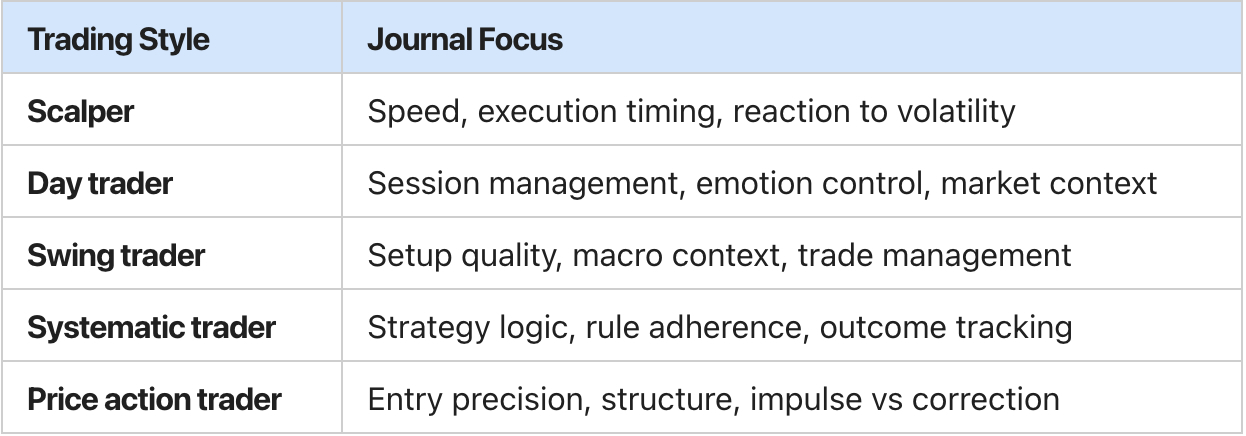
Your journal isn’t just about tracking what happened. It should explain why it happened in a way that fits how you trade.
Ask yourself:
Your answers should shape every input you track.
There’s no need to log 50 data points per trade.
Instead, pick a small set of high-impact metrics that reflect your goals and give you clean, objective feedback.
FX Replay makes this process smoother by letting you auto-record the essentials and add custom tags and notes after each trade.
Pro tip: Rate your trades based on decision quality, not outcome.
Winning on a sloppy setup is more dangerous than losing on a good one.
Raw data is useful. But reflection is where the real growth happens.
That’s why your notes should be written like you’re explaining the trade to your future self—or to a trusted trading buddy.
Use this simple 3-part journaling prompt:
“Trend was bullish. Price formed a higher low into prior resistance. Strong volume spike confirmed interest.”
“Looked for a 5-min breakout above consolidation. Tight risk, RR > 2.5. Entry was aggressive but within plan.”
“Trade worked, but I hesitated. Entered late, gave up 0.3R. Need to pull the trigger when setup is clean.”
Keep it short. Clear. Real.
You’re not writing a novel. You’re building a system of feedback loops.
Most traders journal daily but never step back to look at the big picture.
Your edge doesn’t come from one trade. It comes from patterns across dozens.
That’s why weekly reviews are non-negotiable.
Each week, ask yourself:
FX Replay’s performance analytics make this brutally obvious. You’ll see your most profitable setups, your worst timeframes, your average R/R, and more—all in one dashboard.
This is where your journal turns from a diary into a weapon.
Words lie. Emotions lie. Charts don’t.
That’s why attaching screenshots or using FX Replay’s built-in replay function is a game-changer.
Each trade journal entry should include:
This gives your journal depth—seeing what you saw, when you saw it, with no hindsight.
It’s one thing to say “bad entry.” It’s another to see it on the chart and feel that hesitation or rush again.
That’s how you rewire habits.
Once you’ve logged a few dozen trades, organization becomes the multiplier.
Use tags to slice and analyze your journal in seconds.
Examples:
FX Replay lets you filter and segment by these tags, so in two clicks you can:
This saves hours and delivers precision.
You’re not guessing anymore, you’re studying your own edge.
The journal works only if you use it consistently.
So tie it to your existing workflow:
Keep it light and fast. Don’t let it turn into homework.
If your journaling habit takes longer than the trading itself, you’ll burn out.
Most traders obsess over technicals. Few track psychology.
That’s a mistake.
Your mindset before, during, and after a trade is one of the biggest variables in your performance.
Log things like:
Over time, you’ll spot patterns:
Now you’re not just learning setups—you’re learning yourself.
Forget what YouTube or Twitter tells you.
The best journal is the one that shows you how to trade better tomorrow because it’s built around how you trade today.
It doesn’t need to be complicated.
But it does need to be:
FX Replay was designed to make this kind of journaling feel natural. You can track trades, analyze sessions, and study mistakes faster than ever.
But the real power comes when you take ownership of your own feedback loop.
This isn’t about having a prettier spreadsheet.
It’s about becoming a trader who knows exactly why they’re winning—or why they’re not.
That’s what a journal should do.
Pick ONE thing from this post to add to your journal today.
Whether it’s a new tag, a post-trade note format, or a weekly review habit, start small, stay consistent, and let the data speak.
Couldn't find your question here?
Go check out our Help Center below!
Journaling helps traders understand what’s working, what’s not, and why. It provides structured feedback, highlights patterns, and builds confidence over time.
Include trade data (entry, exit, result), setup context, emotional state, rule adherence, and post-trade reflections. Your journal should be tailored to your trading style.
Daily reflections are valuable, but weekly reviews are critical. They help you spot patterns, refine your edge, and stay accountable to your process.
Start by identifying your strategy type (scalping, swing, etc.) and the key variables that influence your decisions. Build your journal around those inputs—not someone else’s system.
Yes. FX Replay offers integrated journaling tools with trade tracking, screenshots, custom tags, and performance analytics to streamline your feedback loop and boost learning speed.
.png)
.png)