


 Sign in


 FXR BattlesPricing
.png)
Most traders spend their early days consuming information. They study indicators, watch market breakdowns, read strategy threads, and replay charts. On paper, they understand what a good trade looks like.
Then they go live and everything changes.
Execution feels rushed. Losses feel personal. Wins create pressure. Decisions that seemed obvious in hindsight suddenly feel uncertain in real time. The gap between knowing what to do and actually doing it becomes painfully clear.
This gap isn’t solved by more information. It is solved by feedback loops.
Trade journaling is one of the few practices that closes this gap between theory and execution. It makes trading easier and clearer. It turns guesswork into clear observations and replaces memory with real evidence.
For traders using replay platforms like FX Replay, journaling goes beyond simple note-taking. With execution data, screenshots, tags, and review tools all in one place, feedback is immediate instead of scattered. Practice starts turning into clear, measurable progress instead of vague impressions.
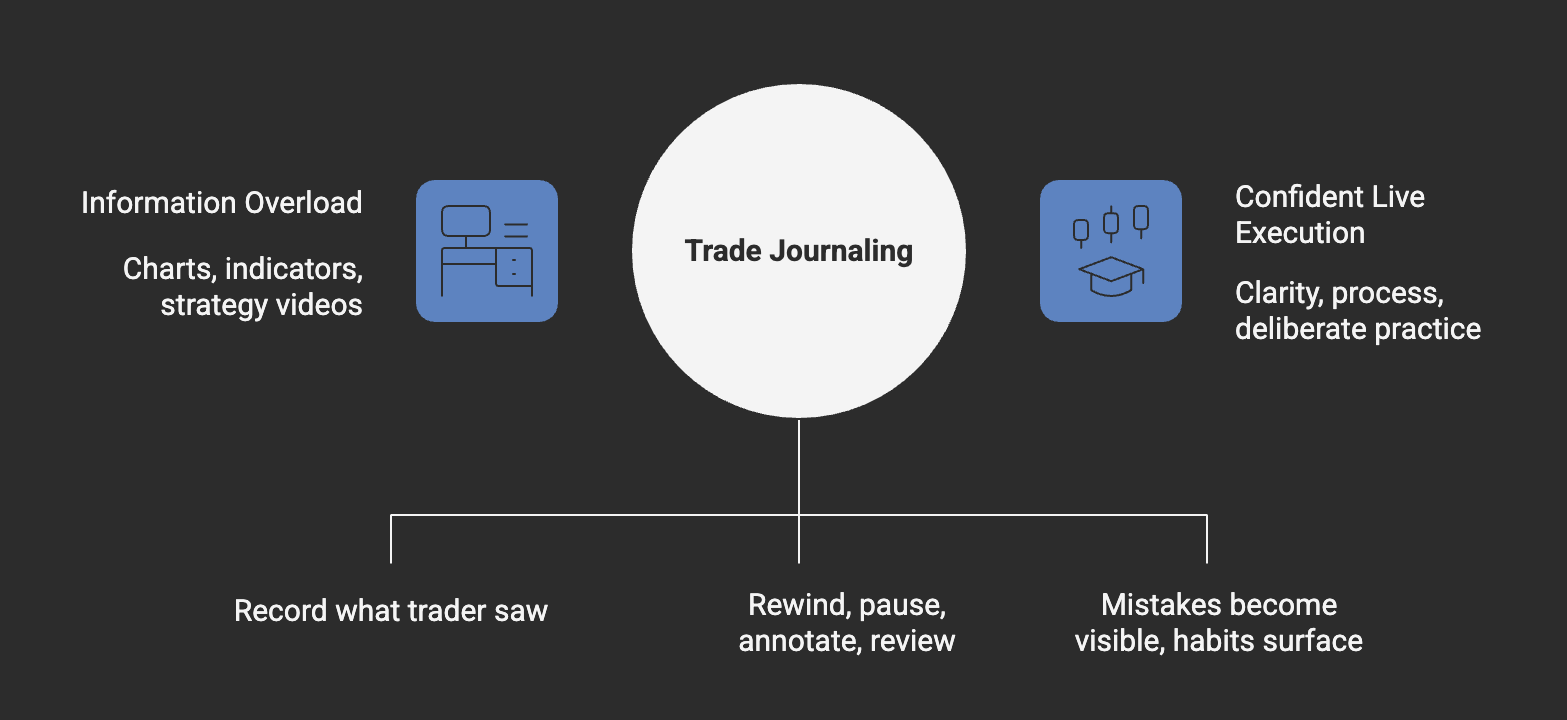
Journaling is often misunderstood as record-keeping.
Many traders think of it as a spreadsheet filled with numbers, screenshots, and statistics. That data matters, but it is incomplete on its own.
A trade journal is a structured record of decisions. It captures:
At its core, trade journaling answers four questions for every trade:
For beginners, this process creates something that charts alone cannot provide - “perspective”.
Without a journal, traders rely on their memory. But memory is selective and unreliable. It highlights recent trades, emotional outcomes, and dramatic moments while quietly discarding context. Journaling replaces that distortion with a consistent, objective record.
What makes FX Replay’s approach distinctive is that journal entries aren’t created manually after the fact. When you execute trades in replay or live sessions, FX Replay automatically logs key data such as entry/exit, direction, size, time, and result. This lets you focus on review and reflection, not transcription.
You can also tag trades with strategy names, confidence levels, session types, and error categories, then filter by those tags later. This kind of journal tagging and filtering is what turns a list of trades into a research-ready dataset.
Most traders believe journaling is something to do later, once they're consistent or profitable.
In reality, early behavior becomes a habit whether it’s observed or not. Journaling makes those habits visible before they calcify.
When trades are documented consistently, patterns surface quickly:
These insights aren’t theoretical. They’re earned through repetition and reinforced through deliberate review.
FX Replay lowers the friction of journaling by automatically capturing execution data and tying it to replay sessions, screenshots, tags, and notes. This makes journaling part of the trading workflow rather than an afterthought.
Most importantly, journaling shifts focus away from outcomes and toward process. A well-executed losing trade is recorded as a success in terms of decision quality. A profitable but impulsive trade is flagged as a failure in discipline.
That reframing — process first, outcome second, is foundational for long-term development. For more on this mindset, see our post on why journaling builds unshakable confidence.
A trading journal does not need to be complex to be effective. In fact, complexity is often the fastest path to abandonment.
The objective is clarity, not perfection.
At a minimum, each entry should capture:
Beyond these basics, context adds depth.
What were the broader market conditions? Was volatility elevated or muted? Was there any news? What was your emotional state before and during the trade?
These details explain outcomes. More importantly, they reveal patterns that raw performance metrics alone cannot surface.
Using FX Replay’s built-in journal and tagging system, traders can attach notes, screenshots, and annotations directly to replay or live sessions. You can also define your own strategy categories or confidence levels, then filter trades by those tags to identify patterns quickly. FX Replay. This removes the need for separate spreadsheets or external tools.
If journaling feels like a chore, it won’t last. When it’s embedded into the trading environment itself, its value compounds.
Replay is where journaling becomes a true development tool rather than a passive record.
Replay-driven platforms like FX Replay allow traders to compress large amounts of market experience into focused sessions. Instead of waiting weeks for a specific setup to appear live, traders can practice it repeatedly under controlled conditions.
Journaling inside replay turns that repetition into feedback.
You can replay identical market conditions multiple times, document execution decisions, and compare outcomes. Over time, familiarity increases, hesitation decreases, and execution quality improves.
Replay also makes mistakes easier to dissect. You can pause, rewind, and review the exact moment a decision was made. Journaling then preserves not only the mistake, but the thinking behind it.
This combination: compressed experience plus structured reflection, is how theory becomes execution skill.
Most traders assume their issues are random. A journal proves otherwise.
When reviewed consistently, journals reveal behavioral patterns that strategy rules alone cannot explain:
They also reveal strengths:
FX Replay’s performance analytics and session breakdowns make these patterns easier to spot by grouping trades by time, setup, or execution behavior, and allowing you to filter your journal by those dimensions.
Instead of asking “What strategy should I trade?”
The question becomes “What decisions do I execute best?”
Moving from replay to live trading is more than a mere technical transition, it’s a psychological one.
Live markets introduce real consequences. Emotions intensify. Small mistakes feel amplified. During this phase, journaling becomes even more important.
A journal creates continuity. It anchors live trading to the same review process used in practice, reducing the temptation to abandon rules under pressure.
Traders using FX Replay can easily compare replay sessions and live trades inside the same analytics framework, making it easier to identify where execution begins to break down—whether through sizing errors, hesitation, early exits, or emotional responses.
Confidence during this transition doesn’t come from winning trades. It comes from recognizing familiar situations and responding deliberately.
Journaling is what makes those situations familiar.
Even disciplined traders undermine their journals by making a few avoidable mistakes:
Excessive metrics and custom fields reduce consistency. If journaling feels time-consuming, it will be abandoned.
Numbers alone don’t explain behavior. Failing to record thoughts and emotional state hides the real drivers of poor decisions.
Wins, especially poorly executed ones, contain critical lessons. Ignoring them creates a skewed picture.
A journal that’s never reviewed is just storage. Growth comes from deliberate, consistent analysis.
FX Replay’s integrated review tools help prevent these issues by making review part of the normal trading workflow rather than a separate task.
To realize the full value of your journal, scheduled, consistent review is non-negotiable. Weekly review works well for most traders.
The purpose of review is not self-criticism, but rather recognizing your patterns. Approach your data objectively to uncover:
This process turns journaling into a record of adaptation. It ensures strategies and execution evolve based on evidence, not assumptions.
Trade journaling is not busywork, and it is not optional.
It is one of the few practices that consistently improves execution across all experience levels. It turns replay into genuine learning, live trading into actionable feedback, and emotional interpretation into evidence-based adjustment.
When journaling lives inside a replay-driven environment like FX Replay, the distance between practice and execution shrinks dramatically.
Repetition builds familiarity, and journaling provides feedback. Together, they accelerate the transition from preparation to confident live execution.
Explore FX Replay. Start practicing with purpose.
Couldn't find your question here?
Go check out our Help Center below!
Trade journaling creates structured feedback by forcing clarity around decisions. When reviewed consistently, it reveals behavioral patterns and recurring mistakes, leading to better execution over time, not outcome chasing.
Focus on decisions, not just results. Each journal entry should include the trade rationale, entry and exit, relevant market context, and your emotional state before and during the trade.
After every trading session. Journals are most effective when entries are written while decisions and emotions are still fresh.
Yes. Journaling exposes emotional patterns over time, making triggers for impulsive behavior easier to recognize and correct deliberately.
Review it regularly with a focus on repeated behaviors, not individual trades. Prioritize execution quality, discipline, and consistency.
.png)
.png)