


.png)
When most new traders look back at their losses, they often blame their strategy. The setup was wrong, the indicator failed, or the market was manipulated.
In practice, charts rarely cause problems, emotional reactions do.
For most traders, trading turns into an emotional tug-of-war between fear, greed, hesitation, and overconfidence.
What makes this especially frustrating is that most traders already know what they should be doing. They understand basic risk management. They can spot reasonable setups. The problem is not a lack of knowledge, but their emotional response to the real trading environment.
This is where a trading journal becomes more than a practice tool. It becomes a psychological training environment.
A simulator puts you under real decision-making pressure without risking capital. You still analyze charts. You still enter and exit trades. You still experience frustration, excitement, and doubt. The difference is that you can observe those emotions instead of paying for them.
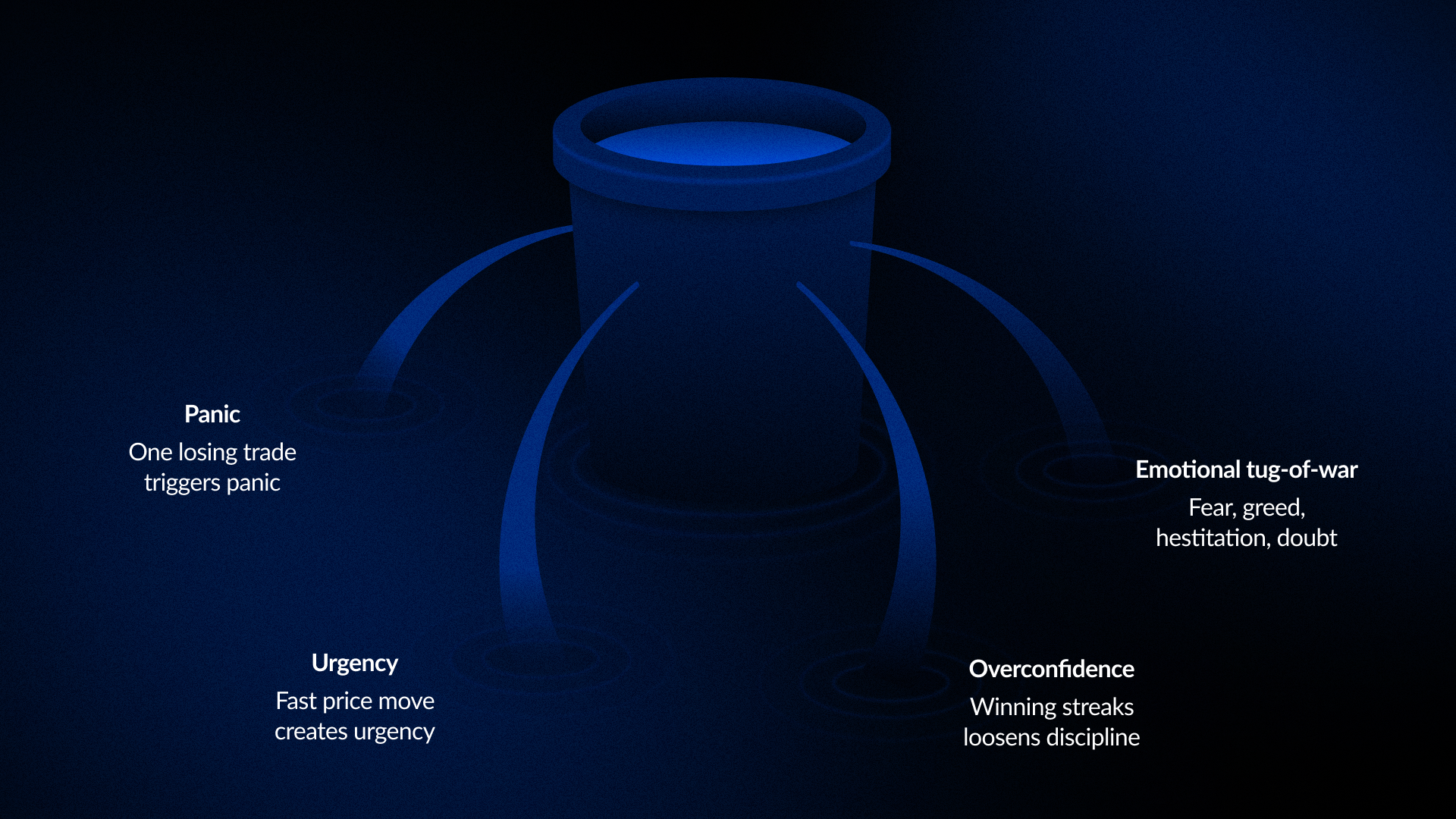
Emotional mistakes are not a character flaw. They are a natural response to uncertainty and risk.
Fear shows up when price moves against you. Greed appears when a trade goes your way and you start imagining how much more it could run. Hesitation follows a loss, leading you to second-guess otherwise valid setups.
The issue is not emotion itself, but acting on it without awareness.
That is why traders cut winners short, hold losers too long, chase missed moves, or revenge trade after a loss. These behaviors rarely happen in isolation. They repeat. They form patterns.
Common emotional patterns include:
A trading simulator helps make those patterns visible.
Trading in a controlled environment and reviewing sessions afterward helps traders recognize recurring behaviors such as exiting early under pressure, increasing size after wins, or freezing after losses.
When combined with structured review and trade journaling, emotional reactions stop feeling random and start becoming predictable.
FX Replay’s built-in journal ties each decision directly to charts, executions, screenshots, and tagged behaviors, turning subjective feelings into reviewable data that can actually be corrected.
Many traders assume emotional control will improve naturally with experience.
They believe emotions will fade once they get used to trading.
That rarely happens.
Live trading often reinforces emotional mistakes instead of correcting them. A fear-based exit that avoids a loss feels justified. A reckless entry that happens to win gets rewarded. The market does not teach discipline, it reinforces whatever behavior worked.
This is where the difference between forward-only practice and historical simulation becomes important. Unlike demo accounts, simulators like FX Replay allow traders to separate decision quality from outcome, a distinction often overlooked in live trading.
In a simulator, traders can clearly see when a good decision loses money and when a bad decision makes money, without the emotional pressure of real capital. That clarity is essential for developing discipline rooted in process rather than short-term results.
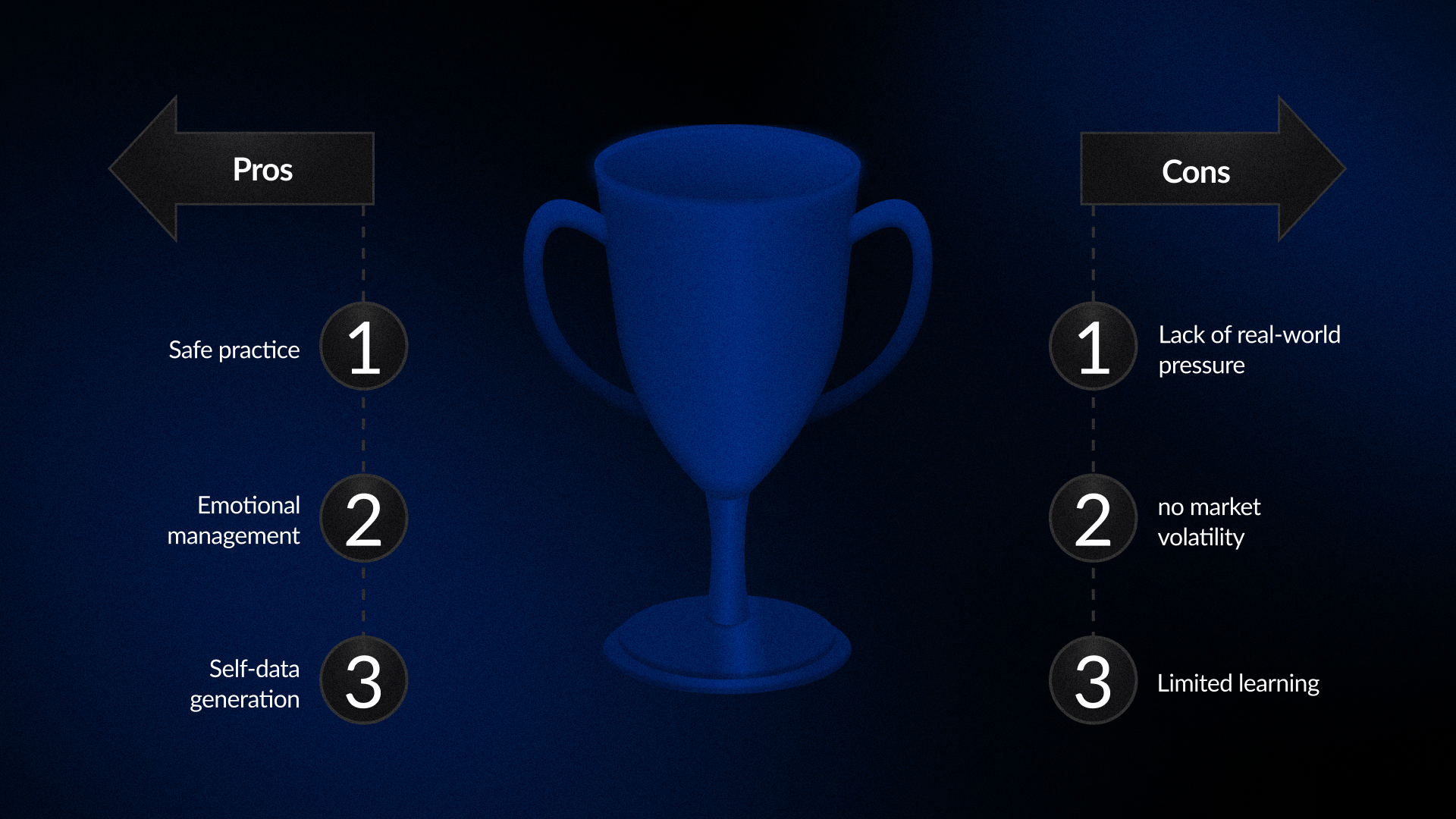
The most obvious benefit of simulation is safety. Traders can make mistakes without financial consequences.
That safety changes behavior. Traders are more willing to take valid setups instead of freezing. They are less likely to force trades after losses and can sit through drawdowns without worrying about immediate account damage.
Emotions do not disappear. They become manageable.
This is why many traders choose to practice in a risk-free environment before committing real capital. Lower emotional intensity makes behavioral patterns easier to recognize and correct.
A trading simulator does more than generate market data. It generates self-data.
Over repeated sessions, patterns begin to emerge. Poor decisions tend to cluster around specific conditions, such as after consecutive losses, during certain times of day, or in volatile markets.
These are the same insights traders uncover when they combine simulation with structured trade journaling.
Instead of asking, “Why did I lose?”, traders begin asking better questions.
This shift turns emotional mistakes into problems that can be analyzed and addressed.
Confidence in trading does not come from hype or optimism. It comes from familiarity.
A simulator builds that familiarity by compressing experience. Traders encounter similar scenarios again and again. Losses stop feeling shocking. Wins stop feeling intoxicating.
This type of confidence is grounded. It is one of the reasons traders who practice regularly in a simulator often feel calmer and more controlled when transitioning to live markets.
Not all trading simulators are equally effective.
A simulator designed for emotional training should closely mirror live trading. That includes realistic execution, authentic price behavior, support for multiple assets and timeframes, and meaningful performance analytics. Without strong review tools, emotional patterns remain difficult to identify.
Many traders begin by comparing platforms or exploring the best trading simulators before committing to one. While the tool itself matters less than how deliberately it is used, realism and structured review are non-negotiable for meaningful emotional development.
FX Replay was built around these requirements. It lets traders backtest strategies using realistic historical market replay, compress years of screen time into focused practice, identify mistakes faster, and validate their edge with data-driven analytics before trading live capital.

One of the fastest ways to undermine emotional stability is by chasing unrealistic outcomes. Large returns, constant wins, or perfect execution create pressure that often leads to emotional decision-making.
Instead, goals should be process-focused. This includes following a trading plan consistently, respecting risk limits, and executing entries and exits cleanly.
A simulator supports this approach by removing financial stress and allowing repetition. Over time, this mirrors how professional traders use simulation to refine discipline rather than chase short-term results.
Trader tip: Stop trying to win every trade. Start trying to trade every rule.
A trading journal is more than a performance log. It acts as a mirror.
Alongside entries and exits, traders should record why they entered a trade, how they felt during it, and what prompted the exit. Over time, clear patterns emerge between emotional states and outcomes. Certain emotions tend to lead to poor decisions, while specific mental states correlate with better execution. This feedback loop accelerates emotional awareness.
Tools like FX Replay’s built-in trading journal make this process more effective by capturing trades automatically and pairing them with structured data. With tagging, logic-based filters, and performance analytics, traders can review executions, isolate recurring patterns, and analyze results with clarity. Each session becomes a repeatable, data-backed lesson rather than a vague memory.
Journaling turns subjective feelings into objective observations.
Many emotional mistakes stem from discomfort — Fear of loss, fear of missing out, fear of being wrong, etc.
Simulation provides a safe environment to practice sitting with that discomfort. Traders can let trades play out, accept losses without immediate reaction, and resist the urge to interfere.
This skill transfers directly to live trading and often separates inconsistent traders from disciplined ones.
Consider a trader who struggles with impulsive entries during volatile market moves. Every fast candle creates an urge to act.
In live trading, this often leads to rapid losses. In a simulator, however, the trader can practice waiting. Volatility is observed without immediate action, and trades are executed only when predefined conditions are met.
Losses still occur, but they are accepted without panic. Over time, trade frequency decreases while trade quality improves. Emotional reactions soften, and decision-making becomes more deliberate.
This structured approach is why simulators are commonly recommended for traders who want to learn in a controlled risk-managed environment. FX Replay allow futures, forex, and stock traders to simulate market conditions, using realistic market replay and analytics. Traders can practice rule-based execution, manage drawdowns, and build confidence under pressure before taking a real evaluation.
The result is preparation without risk, and discipline developed before real capital is on the line.
Trader Tip: Use simulation to judge decisions by process, not outcome.
Emotional discipline does not mean suppressing emotion. It means responding with intention.
Signs of improvement include fewer impulsive trades, faster emotional recovery after losses, and more consistent execution. Losses feel disappointing rather than devastating. Wins feel satisfying rather than intoxicating.
These changes are subtle, but they can be measured through consistent review and analysis.
Moving from simulation to live trading introduces real pressure.
This is why many traders reduce position size when going live. Smaller size allows emotional exposure without overwhelming consequences. During this phase, simulators remain valuable for reinforcement, review, and recalibration, especially for traders preparing for structured evaluations or prop firm challenges.
One common mistake is treating simulation like a game. Overtrading, ignoring losses, or chasing unrealistic returns defeats the purpose. Another mistake is assuming simulated success guarantees live success.
A simulator prepares you. It does not remove uncertainty.
The goal is preparedness, not perfection.
Trading does not punish ignorance as much as it punishes emotional reactions.
A trading simulator creates space to learn, fail, reflect, and improve without draining your account or confidence. It helps build discipline before the stakes are real.
If you are serious about trading, do not rush into the market hoping emotions will disappear. They will not.
Train them first. Practice deliberately. Learn your patterns.
Then step into live trading with clarity.
Couldn't find your question here?
Go check out our Help Center below!
A trading simulator allows traders to experience real decision-making without financial risk. This makes it easier to observe emotional reactions, identify recurring patterns, and correct behaviors before trading live capital.
Common mistakes include fear-based exits, holding losing trades too long, revenge trading, overtrading after winning streaks, and hesitation following losses.
Yes. Repeated exposure to realistic market scenarios, combined with honest review, helps traders build emotional awareness and improve control over time.
Look for realistic market data, support for multiple asset classes, meaningful performance analytics, and an interface that closely reflects live trading platforms.
Consistency matters more than session length. Practicing daily or several times per week helps reinforce discipline, improve decision-making, and build emotional resilience.
.png)
.png)


