


.png)
Prop firm challenges have become one of the most popular pathways for traders looking to access significant buying power without risking personal capital. Whether it’s FTMO, or any other major firm, the premise is the same: prove your edge, demonstrate disciplined risk management, and follow the rules, then get funded.
But here’s the reality most traders discover the hard way:
Prop firm challenges are not just a test of strategy, they are a test of consistency, psychology, and execution under rules-based constraints.
This is exactly where a trading simulator becomes your most powerful preparation tool.
In this guide, we’ll break down how to use a trading simulator effectively to increase your odds of passing a prop firm challenge. We'll also cover specific FX Replay workflows designed to help traders develop the discipline, confidence, and repeatable routines needed to perform under pressure.
Prop firms are designed to filter out undisciplined or unprepared traders. Roughly 85–95% of traders fail the first attempt, and many fail multiple times—not because their strategy is bad, but because their execution and psychology are untested.
A powerful trading simulator helps solve these problems by allowing traders to:
FX Replay takes this a step further by allowing you to trade the past as if it were live, complete with chart replay, order execution tools, session replay, and detailed analytics, making it ideal for challenge preparation.
Before touching the simulator, you need clarity on the constraints you'll be trading under. Every prop firm challenge is a rules game, and not knowing the rules is one of the most common reasons traders fail.
Typical rules include:
Once you know the rules for your firm, build a simulation framework that mirrors them exactly. FX Replay's Prop Firm Simulator makes it easy to create this simulation for yourself.
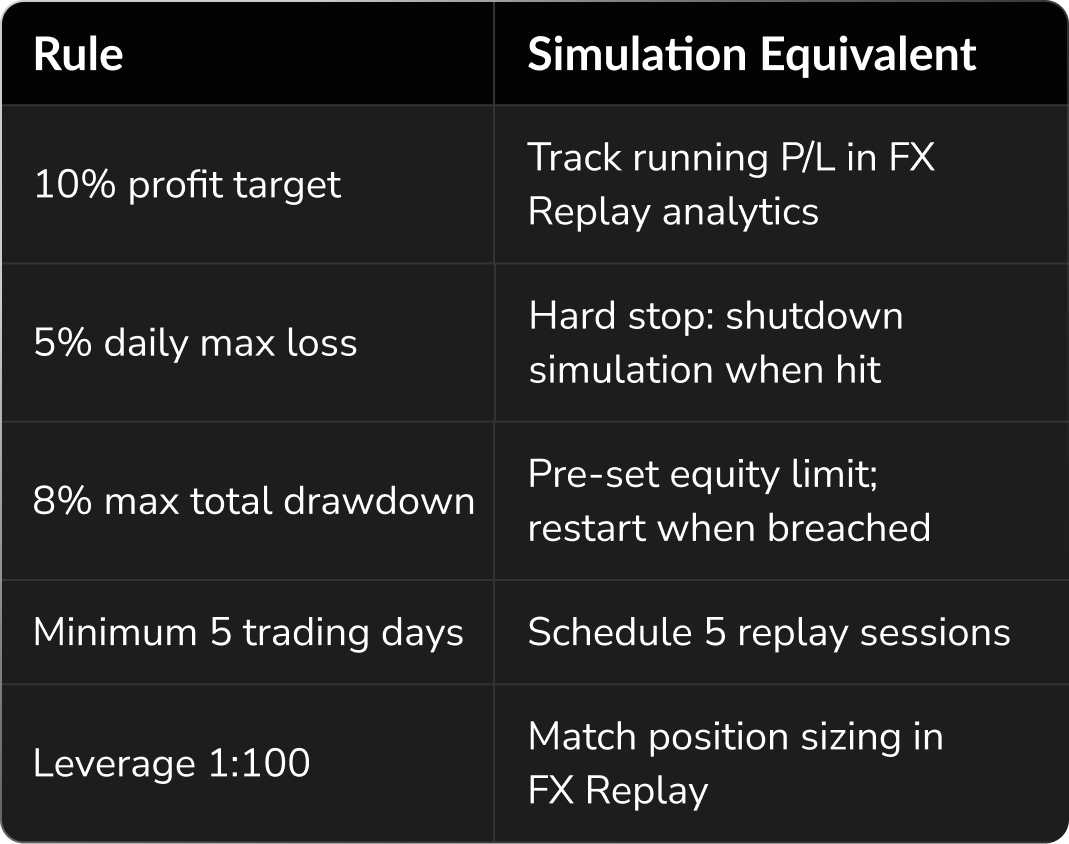
By customizing the simulator to match your challenge’s structure, you create a realistic environment that trains you for the actual experience.
A simulator is not just for practicing execution, it’s also for validating your strategy. Before stepping into the FX Replay Prop Firm Simulator challenge, you should:
Using FX Replay’s backtesting/view mode, you can quickly test years of data to see how your strategy performs across:
Do not skip this step. Practicing an unvalidated strategy wastes time and increases your failure rate in challenges.
Once your strategy is validated, execution practice becomes the priority. Prop challenges are not won by “knowing the strategy.” They are won by executing it flawlessly.
FX Replay’s chart replay is perfect for developing this skill because it allows you to:
You can speed up or slow down price action to practice:
Think of replay as the trading equivalent of a batting cage: you practice the same motions until they become automatic.
To truly prepare for prop firm conditions, you need to simulate not just individual trades, but an entire challenge cycle.
This means replaying multiple days or weeks of market data and following all the rules as if you were in the actual challenge.
Match the firm’s account size (10K, 25K, 50K, 100K, etc.).
Use FX Replay’s analytics dashboard to monitor:
Prop firms reward discipline, not overtrading.
Run simulations through difficult market conditions.
You should train for:
Winning a challenge means surviving bad days gracefully, not avoiding them.
Your first run identifies weaknesses.
Your second run tests if you corrected them.
Your third run builds confidence.
Prop firm traders often say:
“If you can pass the challenge twice in simulation, you are ready to take it live.”
Most traders fail challenges due to psychology, not strategy.
Simulators help you strengthen:
Replay markets with fewer setups.
Force yourself to wait for high-quality entries.
Practice following your plan even when the market tempts you to break rules.
Replay losing streaks on purpose so you can:
Confidence comes from repetition—knowing you’ve executed the same setup correctly hundreds of times.
The more sessions you simulate, the more your emotional reactions flatten. When you eventually take the challenge, you’ll trade from a place of calm control rather than fear or excitement.
FX Replay includes detailed analytics, and this is one of the most important tools for preparing for prop firms.
Here’s what you should review after every simulation session:
Is your strategy producing the expected results?
Are you staying within the challenge’s limits?
Journal every:
These mistakes, not market conditions, are why traders fail challenges.
FX Replay allows you to tag and review trades to spot recurring patterns and errors.
At the end of each simulated week, review:
This creates a professional feedback loop, similar to what institutional traders use.
Once you can pass a prop firm simulation, take it a step further by running real-time replay:
Trade the market exactly as it unfolds in the historical data.
This creates the closest possible environment to a real challenge.
You’ll experience:
This kind of pressure training is what separates prepared traders from unprepared ones.
Before taking your funded challenge, you should have:
Once you're ready, prepare a real challenge routine:
Using the simulator consistently before your challenge dramatically increases your pass rate.
Prop firm challenges are a test of:
A trading simulator, especially one designed to mirror real market conditions like FX Replay, gives you the chance to train these skills in a controlled, repeatable environment.
If you can pass a challenge in the simulator, you can pass it in real life.
Every trader serious about earning funding should invest time into structured simulation practice. It is the single best way to shorten learning curves, build confidence, and trade professionally.
Vous n'avez pas trouvé votre question ici ? Consultez notre centre d'aide ci-dessous !
Centre d'aideA prop firm challenge is a performance evaluation used by proprietary trading firms to determine whether a trader can manage risk responsibly while generating consistent profits. If the trader meets the rules—typically profit targets and drawdown limits—they’re awarded a funded account.
A simulator allows you to practice executing trades in realistic market conditions without risking real money. You can test strategies, build discipline, simulate full challenge cycles, and strengthen your trading psychology. This preparation increases your chances of passing the challenge on your first attempt.
FX Replay lets you replay historical market data as if it were live, giving you control over speed, timeframe, and review options. Unlike a demo account, which only shows current markets, FX Replay allows you to train anytime, repeat scenarios, and accelerate your learning curve.
Most successful traders recommend completing two to three full challenge simulations before attempting a real challenge. If you can pass consistently in a controlled environment, you’ll be better prepared to pass under real pressure.
There’s no single “best” strategy.
The most effective strategies are those that are:
.png)
.png)


