


.png)
Vu de l'extérieur, le trading semble passionnant. Mais quand on le vit, c'est tout autre chose.
Les marchés en temps réel sont stressants, coûteux et impitoyables. Les erreurs s'accumulent rapidement, les émotions prennent le dessus très vite, et quelques mauvaises décisions suffisent à réduire à néant des semaines de progrès, voire tout un compte.
C'est pourquoi presque tous les traders sont confrontés à la même question dès leurs débuts :
Dois-je m'entraîner d'abord sur un simulateur ou me lancer directement sur les marchés réels ?
Sur le papier, les simulateurs semblent parfaits.
Pas d'argent réel en jeu. Pas de conséquences irréversibles. Juste un peu d'entraînement.
Mais cela soulève une véritable question : s'il n'y a pas de risque, l'apprentissage est-il réel ?
La réponse n'est pas simplement oui ou non.
Un simulateur de trading peut être l'un des outils les plus efficaces pour la formation d'un trader, ou une véritable perte de temps.
Tout dépend de la manière dont on l'utilise, de ce pour quoi il a été conçu et des attentes que l'on en a.
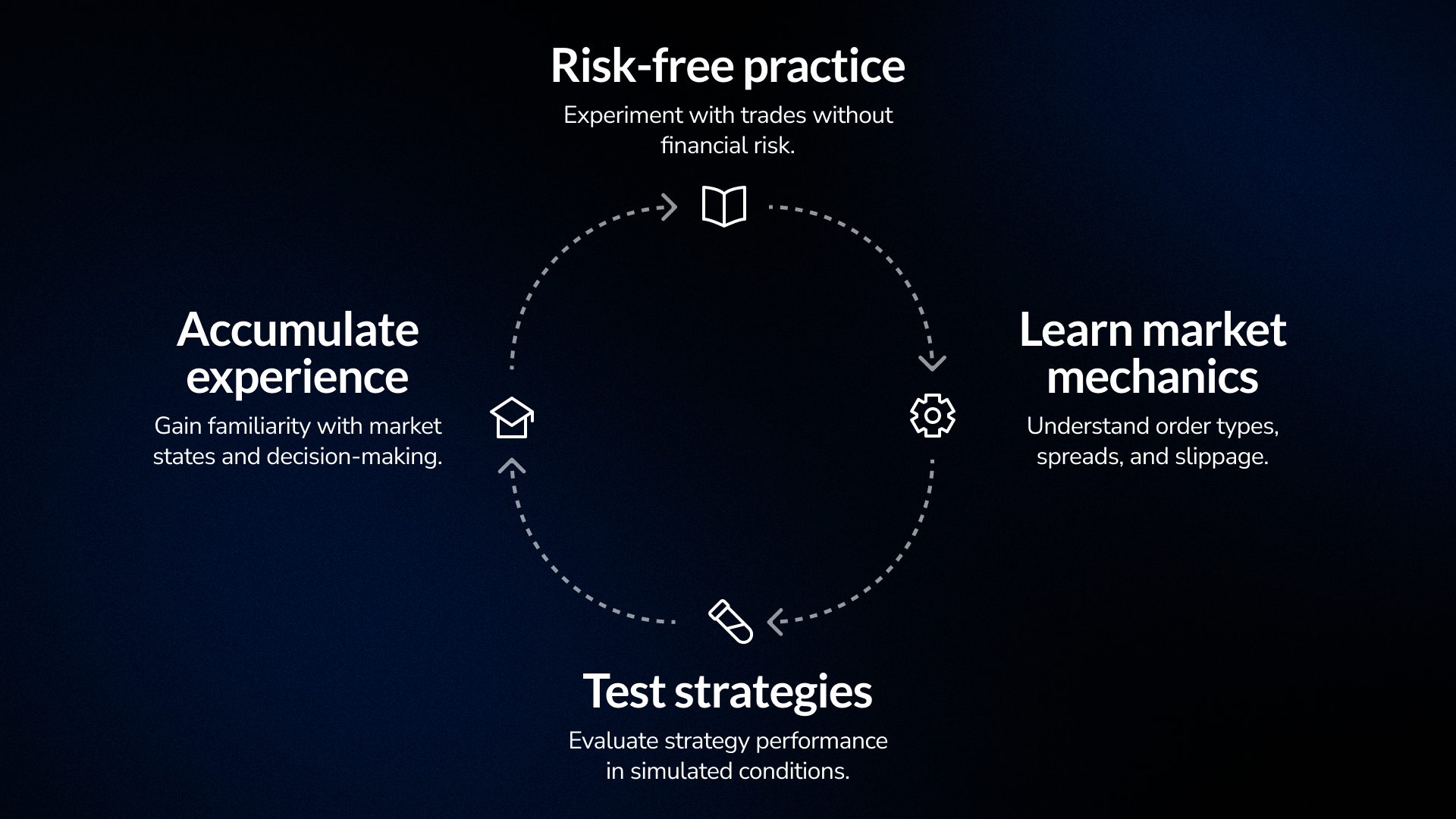
Un simulateur de trading est un environnement d'entraînement qui vous permet d'effectuer des transactions virtuelles à l'aide d'un capital simulé, tandis que l'évolution des cours suit les données réelles ou historiques du marché.
Tous les simulateurs ne se valent pas. Les outils de base se contentent de reproduire les cours en temps réel, tandis que les plateformes plus avancées permettent aux traders de rejouer l'historique des marchés chandelle par chandelle, de contrôler la vitesse d'exécution et d'analyser leurs décisions en contexte.
Les plateformes telles que FX Replay relèvent de cette dernière catégorie, où la simulation ne consiste pas tant à « s'entraîner sur papier » qu'à développer ses compétences de manière structurée grâce à la répétition, à l'analyse et aux données.
Dans un simulateur, les traders continuent de :
La principale différence réside dans le fait que les résultats n'ont aucune incidence sur un compte réel.
Il existe des simulateurs dans tous les marchés : actions, devises, contrats à terme et cryptomonnaies. Ils peuvent fonctionner en temps réel ou à partir de données historiques. Le format importe moins que l'objectif visé.
Un simulateur de trading est conçu pour :
Il n' est pas conçu pour :
Le trading en direct introduit trop de variables à la fois.
Tout cela alors que l'enjeu est financier.
Les simulateurs allègent cette charge cognitive. En éliminant le risque financier, ils permettent aux nouveaux traders de se concentrer sur la compréhension des mouvements du marché et du processus de prise de décision. Cette marge de manœuvre accélère l'apprentissage initial et aide les traders à saisir les mécanismes du marché avant que les conséquences ne deviennent réelles.
Les simulateurs permettent aux traders de se mettre immédiatement dans la peau d'un trader. Pas de paperasse. Pas d'apport financier. Pas de crainte de perdre tout son capital dès le premier jour. Cet accès immédiat rend l'apprentissage plus accessible.
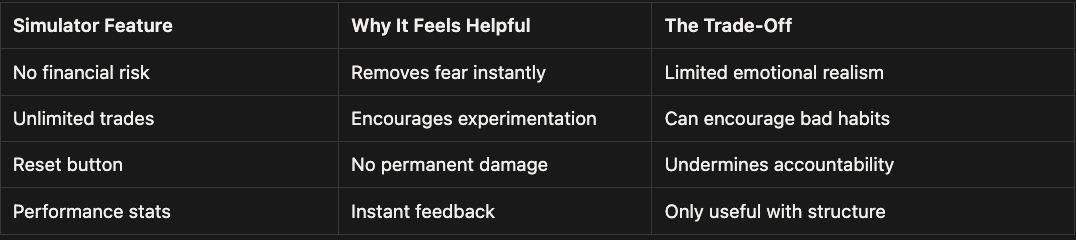
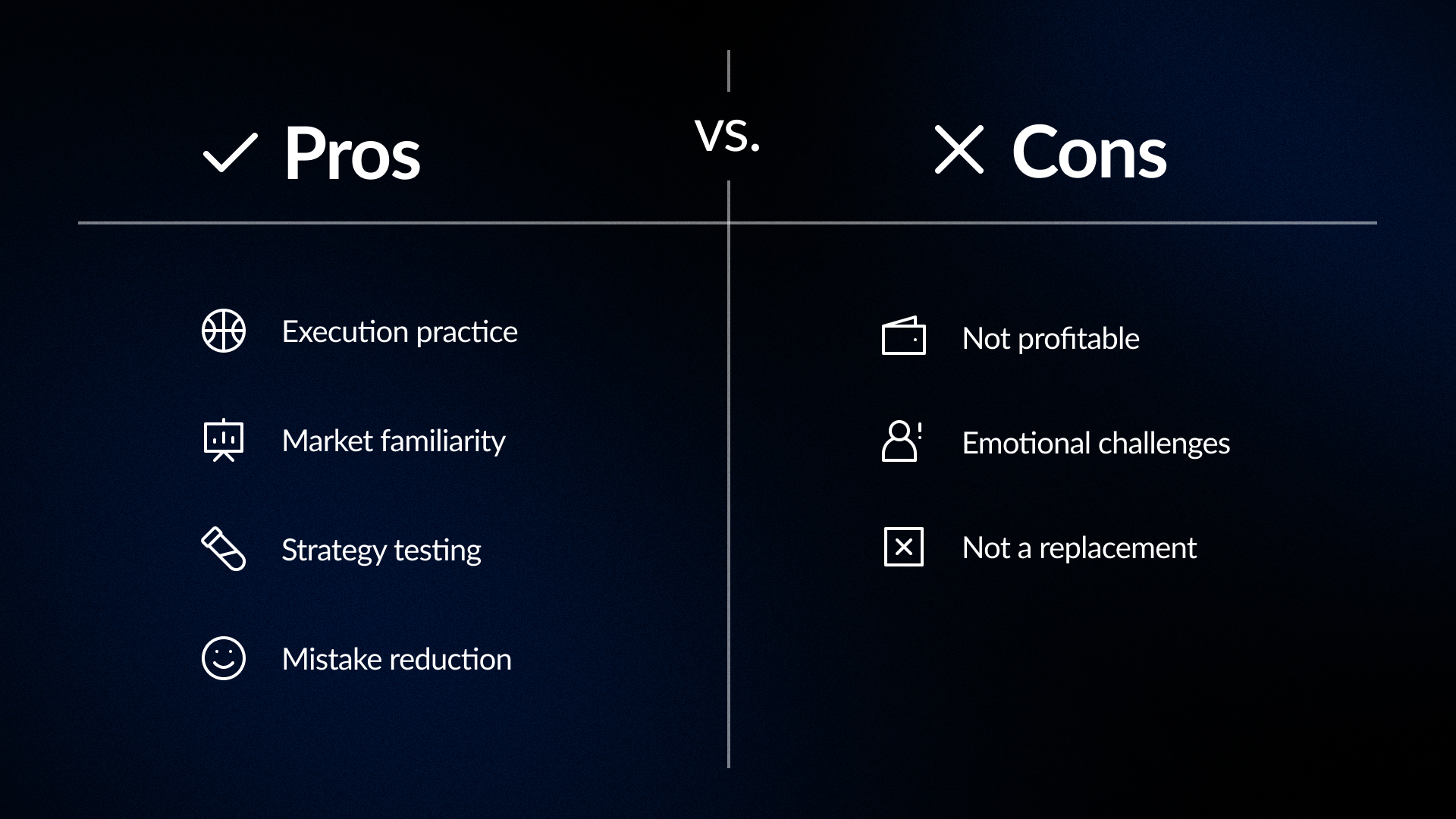
Utilisés à bon escient, les simulateurs offrent plusieurs avantages réels.
Tous les traders font des erreurs.
La différence réside dans le fait que ces erreurs coûtent de l'argent ou servent de retour d'expérience.
Les simulateurs permettent aux traders de s'exercer, d'observer les résultats et d'apprendre sans subir de pertes financières. Cela s'avère particulièrement utile au début, lorsque les erreurs sont fréquentes et souvent évitables.
De nombreux traders choisissent de s'entraîner au trading sans prendre de risques dans un premier temps, non pas pour éviter toute perte, mais pour éviter les pertes inutiles.
Les simulateurs sont efficaces pour comprendre le fonctionnement réel des marchés.
Cette maîtrise technique permet de réduire les difficultés par la suite. Les traders qui comprennent comment se comportent les positions une fois ouvertes ont tendance à commettre moins d'erreurs évitables lorsqu'ils passent au trading en direct.
Avant de mettre en jeu des fonds réels, les traders peuvent recourir à la simulation pour observer le comportement réel d'une stratégie.
La simulation permet de répondre rapidement à ces questions, surtout lorsqu’elle est associée à la relecture structurée et au backtesting. Grâce à la relecture, les traders peuvent se plonger directement dans des conditions de marché spécifiques — volatilité liée à l’actualité, séances à faible liquidité ou scénarios familiers — au lieu d’attendre que ces situations se produisent en temps réel. C’est ainsi que de nombreux utilisateurs de FX Replay abordent l’entraînement ciblé.
La simulation permet de condenser l'expérience. Plutôt que d'attendre des mois pour que les conditions idéales se présentent, les traders peuvent rejouer des sessions passées et s'entraîner à plusieurs reprises à des scénarios similaires, ce qui leur permet de se familiariser avec les différentes conditions du marché : tendances, phases de consolidation, variations de volatilité et transitions.
La possibilité de mettre en pause, de revenir en arrière et de rejouer la même séquence facilite la compréhension
pourquoi une décision a échoué, et pas seulement qu' elle a échoué.
Lorsque les ordres d'exécution, les niveaux de stop et les objectifs sont analysés directement sur le graphique, l'apprentissage est plus rapide, plus clair et plus concret.
Si les simulateurs présentent des avantages évidents, ils ont également des limites bien réelles que les traders doivent bien comprendre.
La principale limite réside dans le réalisme émotionnel.
Quand il n'y a pas d'argent en jeu, les décisions prennent une autre dimension. Les pertes sont plus faciles à accepter. Il est plus facile d'enfreindre les règles. La confiance peut grandir trop vite.
Une stratégie qui semble facile à mettre en œuvre en simulation peut s'avérer déconcertante dès lors que l'on y engage des fonds. Cet écart émotionnel surprend de nombreux traders.
Les simulateurs ne doivent pas être considérés comme des substituts émotionnels au trading réel. Ils permettent de se préparer à l'exécution des ordres, mais ne reproduisent pas parfaitement la pression.
Tous les simulateurs ne modélisent pas l'exécution de la même manière.
Les marchés en temps réel comprennent :
Certains simulateurs simplifient ces facteurs. Cela signifie que les résultats ne sont pas parfaitement transposables.
Une série de transactions simulées fructueuses peut convaincre les traders qu'ils sont « prêts », même si ces résultats sont dus à des conditions favorables ou à des critères peu rigoureux.
C'est l'une des erreurs les plus courantes liées aux simulateurs.
Les simulateurs ne sont généralement pas efficaces pour les traders en raison de la manière dont ils sont utilisés, et non de leur nature même.
Parmi les erreurs courantes, on peut citer :
Conseil de pro : si votre stratégie de simulation ne tiendrait pas la route avec de l'argent réel, c'est qu'elle vous inculque de mauvais réflexes.
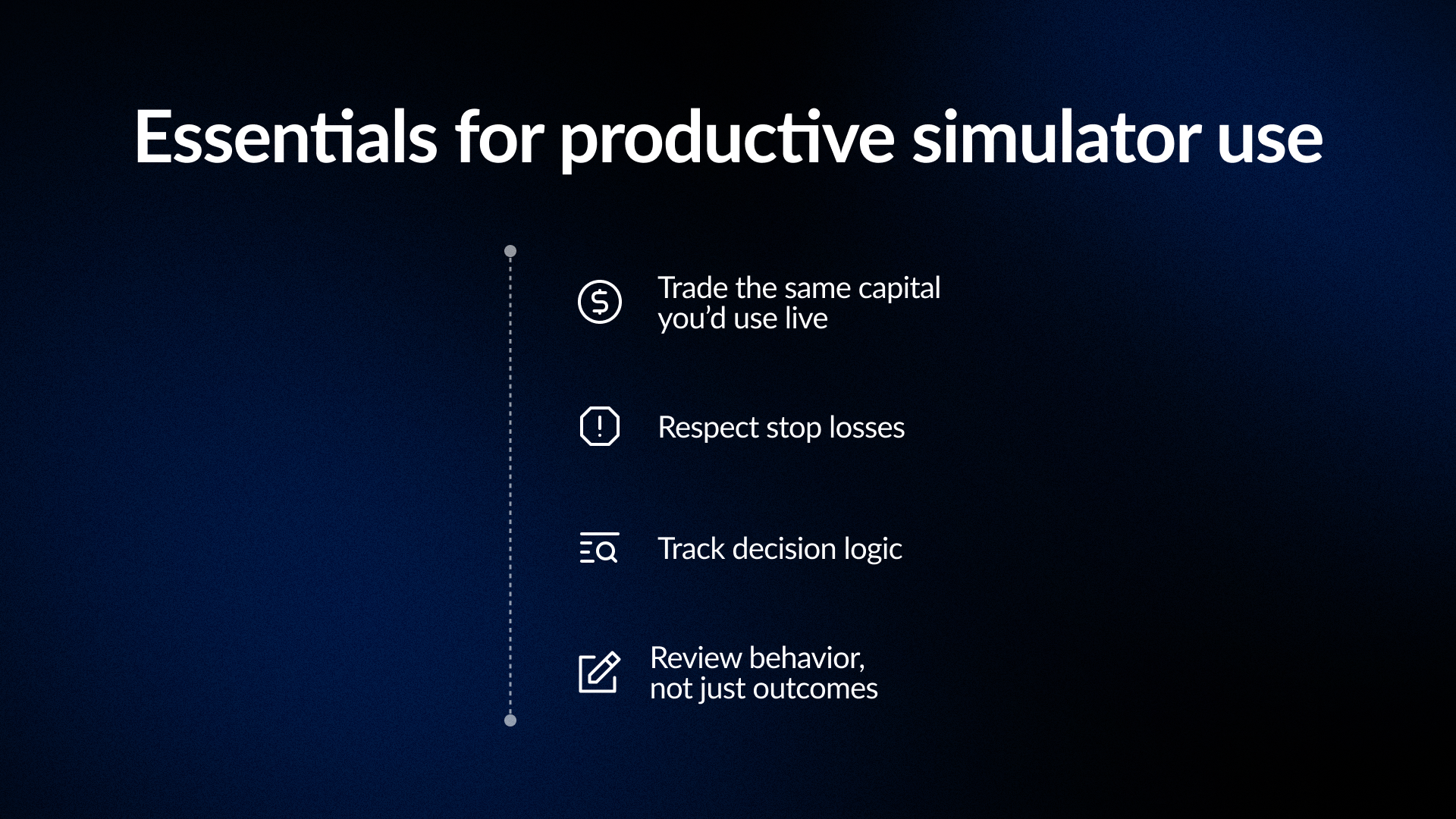
La structure est plus importante que les outils.
Pour utiliser efficacement un simulateur, il faut commencer par :
Et surtout : relisez-le.
La tenue d'un journal est essentielle pour progresser de manière significative. Dans FX Replay, les transactions sont automatiquement consignées au sein même du simulateur, ce qui permet aux traders de passer en revue leurs exécutions directement sur le graphique, d'annoter leurs décisions, de filtrer les données par type de configuration ou d'erreur, et de relier leurs notes émotionnelles à l'évolution réelle des cours plutôt qu'à de simples chiffres isolés.
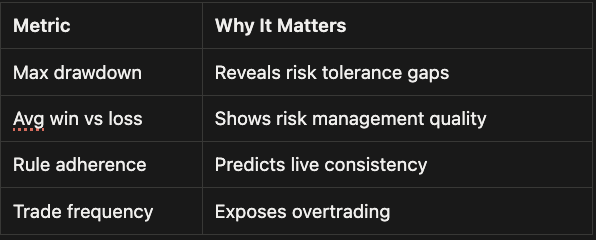
À un stade précoce, le profit seul constitue un indicateur peu fiable. Une évaluation plus pertinente doit porter sur la régularité de l'exécution, les baisses de capital, la maîtrise des risques et le respect des règles.
Les simulateurs avancés tels que FX Replay facilitent cette démarche en associant la fonctionnalité de relecture à l'analyse des performances — en suivant les baisses de capital, l'espérance mathématique et les statistiques temporelles —, ce qui permet aux traders d'évaluer la régularité de leurs résultats plutôt que de se fier uniquement à quelques transactions fructueuses.
Les indicateurs ne prennent tout leur sens que lorsque le comportement est stable. C'est pourquoi de nombreux traders associent la simulation à un backtesting structuré, afin de distinguer la qualité de la stratégie des erreurs d'exécution.
Il est utile d'utiliser un simulateur si vous souhaitez :
Il ne vaut pas la peine de l'utiliser si :
Les simulateurs sont des outils de formation ; ils ne remplacent pas la mise en œuvre réelle.
C'est lors du passage au trading en direct que l'on se rend vraiment compte de la réalité.
Même les traders sur simulateur les plus disciplinés sentent leurs émotions s'intensifier dès qu'il s'agit de capital réel. C'est tout à fait normal.
La transition la plus saine est celle qui se fait progressivement :
De nombreux traders continuent d'utiliser des simulateurs parallèlement au trading en conditions réelles pour tester des ajustements, s'entraîner à différents scénarios ou se préparer à des environnements structurés, tels que les évaluations au sein de sociétés de trading pour compte propre.
La plupart des simulateurs de trading se concentrent sur la passation d'ordres dans l'instant présent. Si cela permet de maîtriser les mécanismes de base, cela limite toutefois la pratique réfléchie.
FX Replay adopte une approche différente. Au lieu de s'en remettre à une exposition aléatoire au marché, cette plateforme permet aux traders de condenser des années de comportement boursier en sessions de formation ciblées. Les traders peuvent tester leurs idées dans différents contextes, s'entraîner à plusieurs reprises à gérer des situations difficiles et analyser leurs décisions en tenant compte de l'ensemble du contexte historique, transformant ainsi la simulation en un exercice d'entraînement ciblé plutôt qu'en un simple trading sur papier passif.
Conçu autour d'une reproduction boursière historique en temps réel, boursière par boursière, FX Replay permet aux traders d'isoler des scénarios spécifiques : séances volatiles, marchés calmes ou configurations récurrentes, et de s'y exercer à maintes reprises.
La relecture, l'exécution, le backtesting et la journalisation s'inscrivent tous dans un même flux de travail, ce qui permet d'analyser les transactions dans leur contexte plutôt que sous forme de statistiques isolées.
C'est pourquoi de nombreux traders utilisent FX Replay non seulement comme un simulateur, mais aussi comme un environnement de formation structuré.
Conseil de pro : si vous ne parvenez pas à expliquer pourquoi une transaction a échoué en revue, l'erreur se reproduira en temps réel.
Un simulateur de trading vaut le coup si l'on comprend ce qu'il est et ce qu'il n'est pas.
Un simulateur de trading ne vous rendra pas rentable. Il n'éliminera pas vos émotions. Il ne garantira pas votre réussite.
Voici ce qu'il permet de faire :
Pour les traders qui souhaitent apprendre correctement, la simulation constitue un élément essentiel du processus.
Vous n'avez pas trouvé votre question ici ?
Consultez notre Centre d'aide ci-dessous !
Oui, à condition que cela serve à acquérir des compétences, à perfectionner son exécution et à développer sa discipline, plutôt qu'à courir après le profit.
Non. Cela vous prépare au trading en conditions réelles, mais ne reproduit pas entièrement la pression émotionnelle.
Jusqu'à ce que vous soyez capable de respecter les règles de manière systématique et de gérer les pertes sans réagir de manière émotionnelle.
Une confiance excessive fondée sur des résultats qui ne s'appuient pas sur une exécution rigoureuse.
Oui. Beaucoup s'en servent pour tester des idées et peaufiner leur mise en œuvre sans prendre de risques.
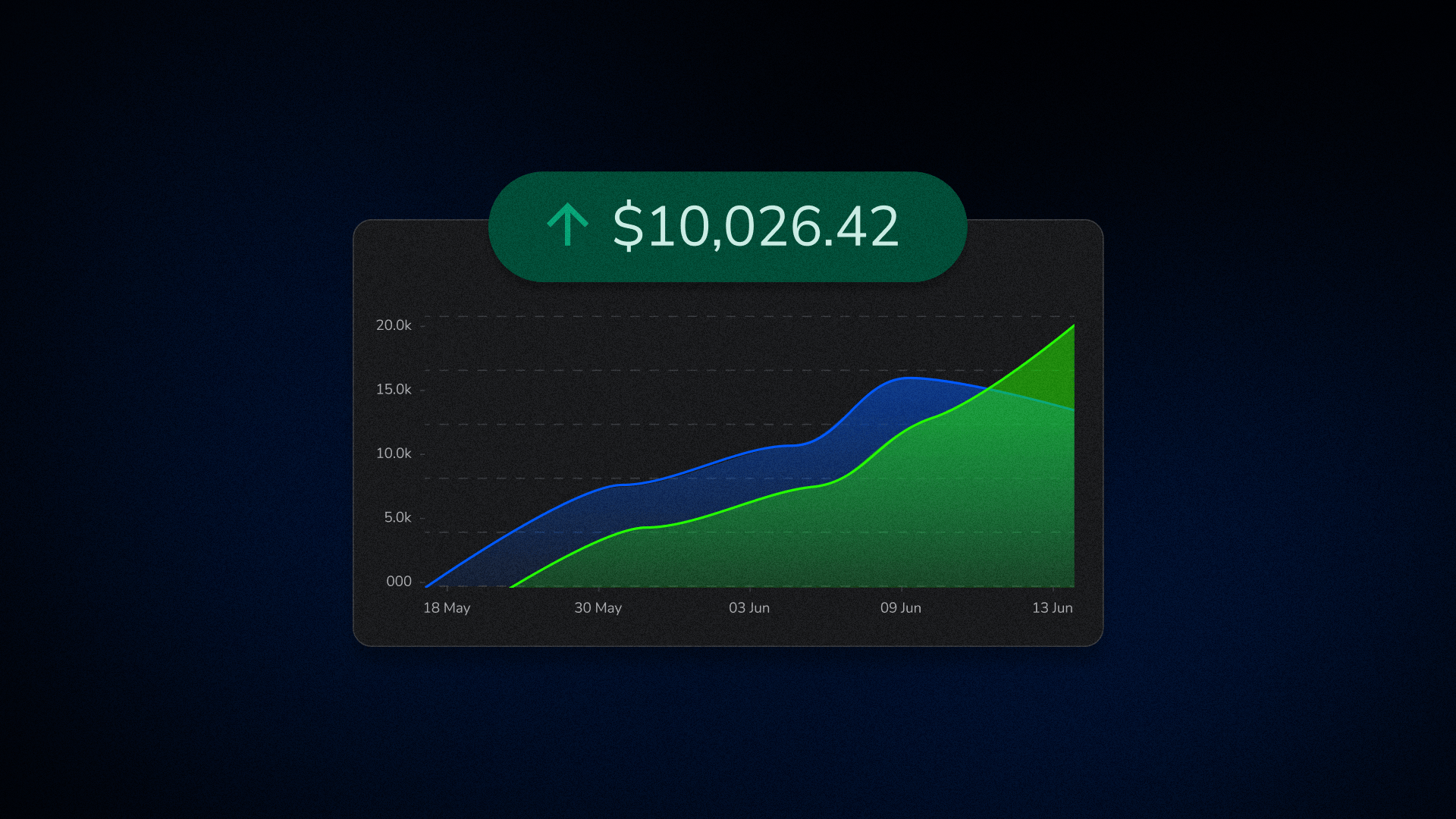
Découvrez comment le backtesting permet de réduire les risques liés au trading, de renforcer véritablement la confiance et d'aider les traders à valider leurs stratégies à l'aide de données. Apprenez à tester, affiner et mettre en œuvre vos stratégies en toute clarté.
.png)
Guide pratique d'utilisation d'un simulateur de trading sur contrats à terme. Découvrez comment le réalisme de l'exécution, les exercices structurés et la formation par la relecture aident les traders à développer leurs compétences avant d'engager leur capital.


