


.png)
Most trading mistakes are expensive. Not just financially, but psychologically.
A few poorly managed trades can damage confidence, create hesitation, and reinforce bad habits that take months to correct. Many traders experience this early in their journey because they learn directly in live markets.
But there is a better way to build experience.
A trading simulator allows traders to practice strategies, test decision-making, and refine execution without risking real capital. Instead of learning through costly mistakes, traders can identify and correct problems in a controlled environment.
Used properly, a simulator becomes one of the most powerful tools for developing consistent trading performance.
Most mistakes in trading do not come from lack of intelligence or effort.
They come from lack of experience.
New traders are forced to make complex decisions in fast-moving markets:
Without enough exposure to real market behavior, these decisions become guesses rather than calculated actions.
Common mistakes include:
These errors are normal during the learning process. The problem is that when they occur in live markets, they often result in financial losses.
A trading simulator removes that risk while preserving the learning experience.
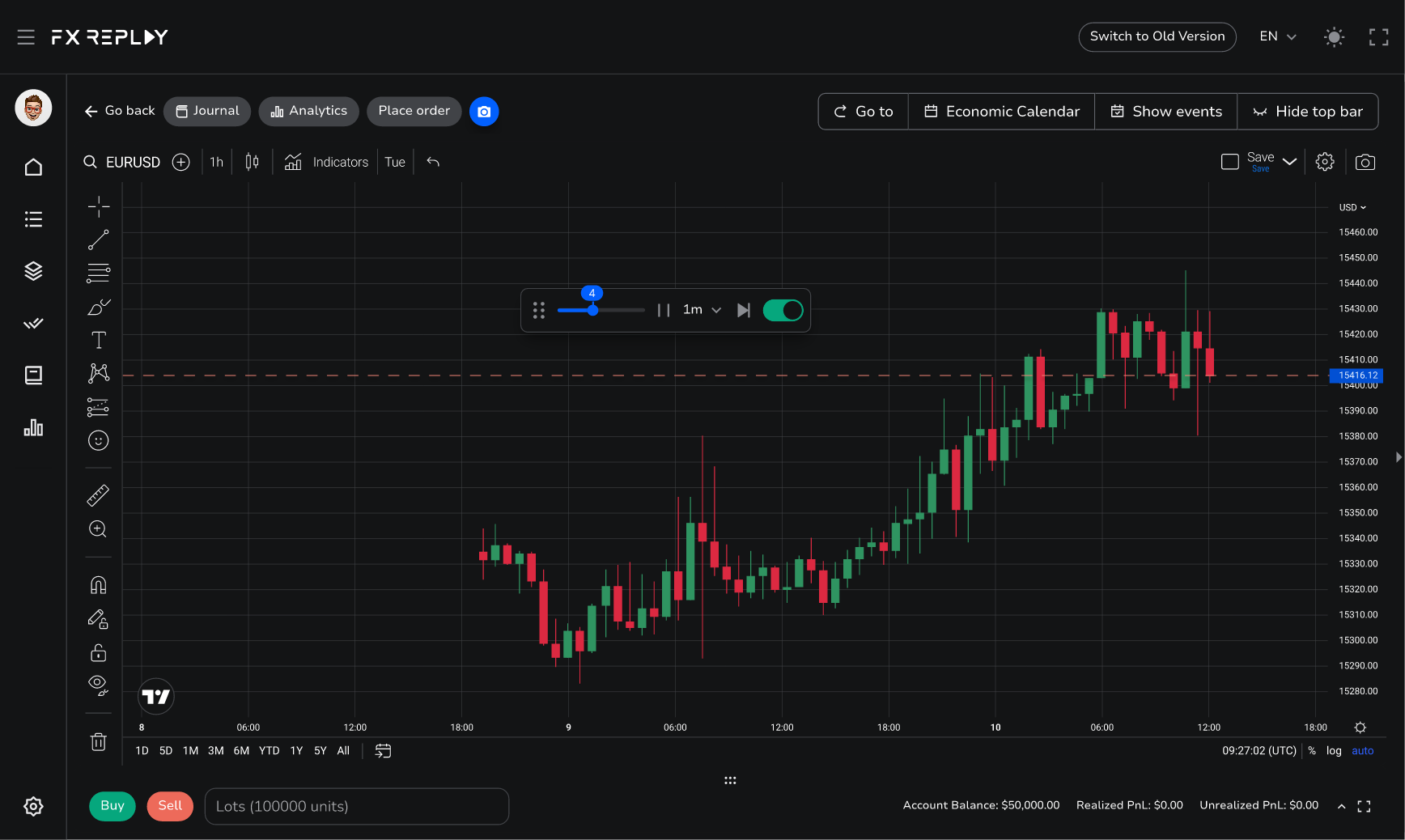
A trading simulator recreates real market conditions using historical or live data.
Instead of watching charts passively, traders interact with the market as if it were live. They can:
Because the market data is real, the price movements behave exactly as they did historically.

This allows traders to experience authentic market scenarios without financial pressure.
Over time, this practice builds the experience that traders normally gain through years of live trading.
One of the biggest advantages of a trading simulator is the ability to make mistakes safely. Early in the learning process, mistakes are inevitable.
Traders may:
In a live account, these mistakes cost real money. In a simulator, they become valuable lessons.
Traders can review each trade, understand what went wrong, and correct the behavior before trading with real capital; this dramatically reduces the cost of the learning curve.
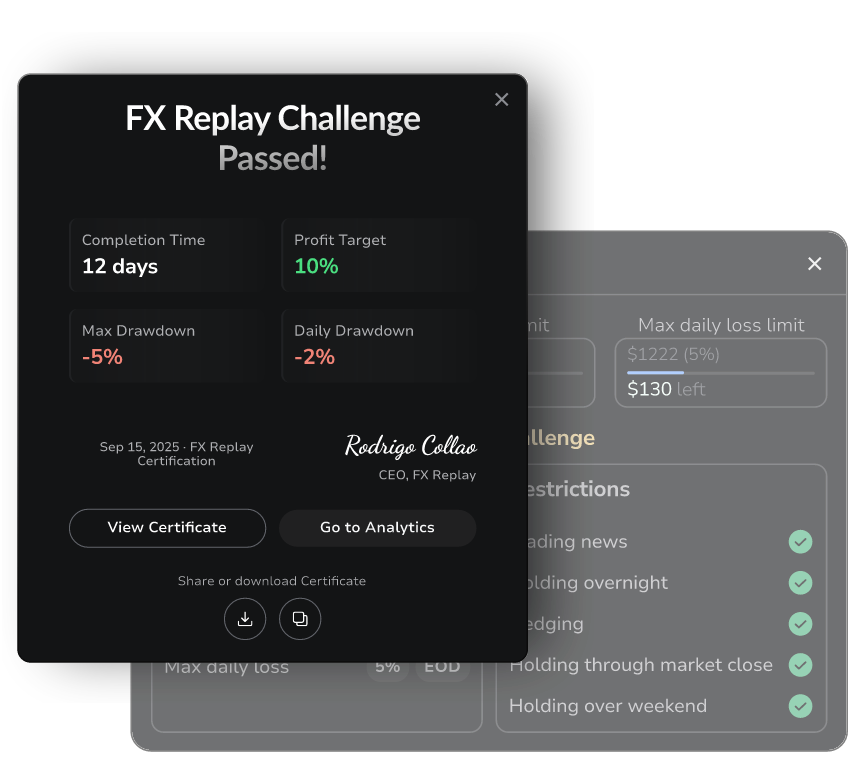
FX Replay has even created a Prop Firm Simulator as a way to simulate your rules, and ensure you're more likely to pass your funding challenges.
Many traders jump into live markets with strategies that have never been properly tested.
They see a setup work a few times and assume it will remain profitable.
This approach is dangerous.
Without testing across many market conditions, traders have no idea whether a strategy is actually reliable.
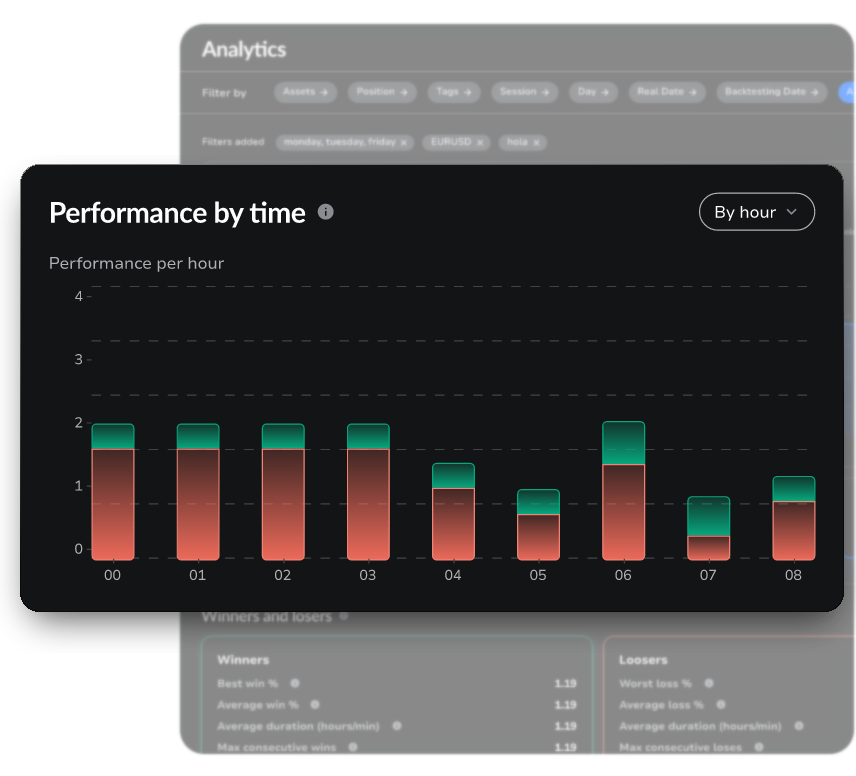
A trading simulator allows traders to test strategies across large samples of trades.
For example, traders can evaluate:
Once a strategy has been tested across 100 or more trades, traders gain a much clearer understanding of its strengths and weaknesses.
This data-driven approach removes much of the uncertainty involved in trading. See our strategy guides here if you're looking for a new strategy to test yourself.

Even a strong strategy can fail if execution is inconsistent.
Many traders struggle with:
These execution errors often come from lack of repetition.
A trading simulator provides the screen time needed to build consistent habits.
By repeating trades under realistic conditions, traders develop stronger discipline and faster decision-making.
Over time, execution becomes more automatic and less emotional.
.png)
Markets behave differently depending on conditions.
Trending markets, ranging environments, high-volatility sessions, and news-driven moves all require different responses from traders.
A trading simulator exposes traders to these different environments.
Instead of waiting weeks or months to experience certain scenarios in live markets, traders can replay historical data and encounter them immediately.
This exposure builds a deeper understanding of how markets move and how strategies perform under different conditions.
The result is a trader who is far better prepared when similar scenarios appear in live markets.
Confidence in trading should come from data, not hope.
Many traders struggle with hesitation because they do not fully trust their strategies.
They may:
This lack of confidence often comes from insufficient testing.
When traders use a simulator to test hundreds of trades, they begin to see clear patterns in their results.
They understand:
This evidence builds real confidence.
Traders are no longer guessing whether their strategy works. They have seen the results repeatedly through structured testing.
One of the biggest limitations in trading is time.
In live markets, valid setups may only appear a few times per week. This means it can take months to gather meaningful experience.
A trading simulator dramatically speeds up this process.
Instead of waiting for the market, traders can replay historical price data and test setups continuously.
This allows traders to:
What might normally take years of screen time can often be compressed into months of focused practice.
Not all simulators are equally effective.
The most powerful platforms allow traders to replay historical markets exactly as they unfolded.
This creates a realistic environment where traders must react to price movements in real time.
Market replay provides several key benefits:
This combination allows traders to study the market in far greater depth than traditional chart review.
FX Replay is designed to replicate real trading conditions while allowing traders to practice at accelerated speed.
Using historical market data, traders can replay past price action and interact with the market as if it were happening live.
This allows traders to:
Because the platform integrates simulation, journaling, and analytics, traders can easily analyze their results and refine their strategies.
Traders who practice with a simulator often avoid several of the most common early mistakes.
These include:
Overtrading
Many new traders take too many trades because they lack patience. Simulation helps reinforce discipline by reviewing trade quality rather than quantity.
Poor Risk Management
Traders quickly see how improper position sizing or wide stop losses impact performance.
Strategy Hopping
Without testing, traders constantly change strategies. A simulator allows traders to evaluate ideas thoroughly before abandoning them.
Emotional Decision Making
Repeated practice helps traders develop structured decision-making that replaces emotional reactions.
These improvements significantly increase the chances of long-term success.
Trading is a skill, and like any skill, it improves through structured practice.
Watching charts alone is not enough.
Real improvement comes from:
A trading simulator creates the environment where this process can happen efficiently.
Instead of learning through costly losses, traders gain experience in a controlled setting where mistakes become valuable feedback.
Costly trading mistakes are often the result of inexperience, not lack of effort.
A trading simulator allows traders to build that experience before risking real capital.
By practicing strategies, improving execution, and reviewing performance data, traders can refine their approach and develop confidence in their decisions.
Platforms like FX Replay make this process easier by combining realistic market replay with powerful testing and analysis tools.
For traders who want to approach the market with preparation and discipline, a simulator is one of the most valuable tools available.
¿No has encontrado aquí tu pregunta? Consulta nuestro Centro de ayuda.
Centro de ayudaA trading simulator is a platform that allows traders to practice buying and selling in a simulated market environment. It uses historical or live market data to replicate real trading conditions, allowing traders to test strategies without risking real money.
A trading simulator allows traders to practice decision-making, risk management, and execution in a risk-free environment. By simulating real market conditions, traders can identify strategy weaknesses and correct mistakes before trading with real capital.
Yes. A trading simulator helps traders build experience by practicing entries, exits, and strategy rules. Repeating trades in a simulated environment helps improve execution, discipline, and understanding of market behavior.
Modern simulators use historical market data to recreate real price movement. Platforms like FX Replay allow traders to replay past market conditions, helping them experience realistic setups and practice trading in a controlled environment.
A trader should consider going live once their strategy shows consistent results over a large number of simulated trades. This usually includes stable win rates, controlled drawdowns, and clear execution of strategy rules.
.png)


